From the blog
What Are Sukre and Metabolyte? Two Trademarks, Read Against the Published Papers
Our ingredients page says the seller’s material does not explain Sukre or Metabolyte. Two 2026 papers in the International Journal of Toxicology do: they describe Sukre as a purified L-arabinose from acacia, and Metabolyte as sodium dodecanedioate. L-arabinose has human trials showing it can blunt the blood-sugar rise from sucrose in a drink, but not reliably in mixed meals. Dodecanedioate has human studies as an energy fuel, but none we found on weight loss. No amount is published for either.
What our ingredients page says, and what changed
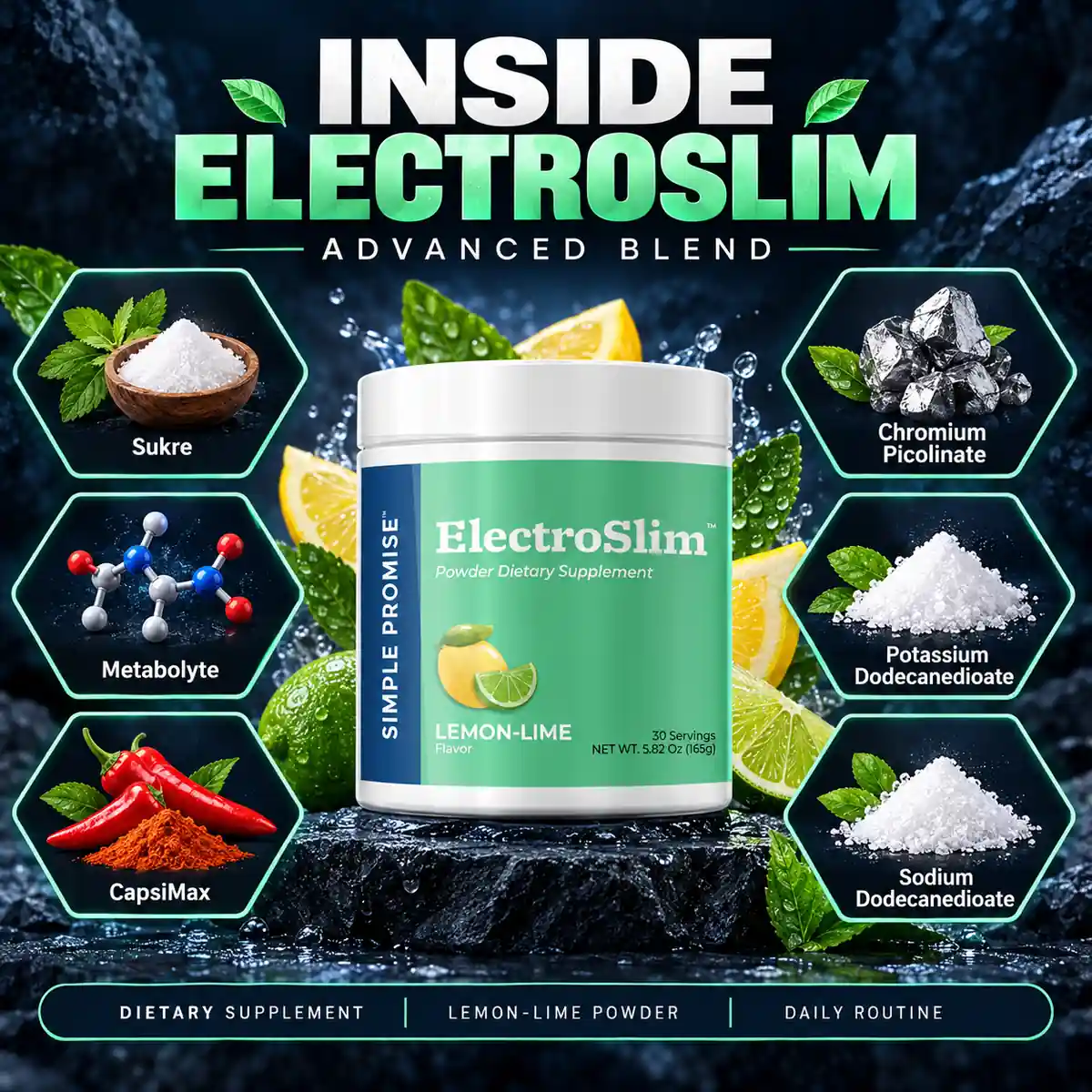
Our ingredients page carries one uncomfortable line about two of the six names on the ElectroSlim tub: Sukre™ and Metabolyte™ are trademarks, and the material we were given does not say what they are made from. We would not guess, so we listed them as names on a picture.
That line is still true of the seller’s material. What has changed is the published literature. When we searched PubMed for each name, both turned up in the same journal in 2026, in safety studies of the branded materials. Neither paper is about ElectroSlim, and neither says anything about weight. But they do say what the trademarks refer to, which is more than the seller’s pack does.
People are already asking. Search engines suggest questions such as “what are the ingredients in ElectroSlim” and “what is Sukre made from”, and the honest reply used to be “nobody has said”. This article is the updated reply: what the papers identify, what the research on each substance actually shows, and where the trail goes cold.
The two papers that name the trademarks
The first paper is a genotoxicity and 28-day oral toxicology evaluation of Sukré™, which its abstract describes as a highly purified L-arabinose produced from hydrolysed acacia, with potential uses as a natural sweetener. The tested material came from Compound Solutions, Inc, USA. In rats given up to 7,200 mg per kg of body weight a day for 28 days by gavage, the authors saw no mortality, morbidity or adverse effects, and set the no-observed-adverse-effect level at 7,200 mg/kg/day, the highest dose tested. Their in vitro tests found it non-mutagenic and non-clastogenic (Dziwenka and Emmel, International Journal of Toxicology, 2026, PMID 41093367).
The second paper is a safety assessment of Metabolyte™, which its abstract identifies as sodium dodecanedioate (the title calls it dodecanedioic acid disodium salt). It reports a battery of genotoxicity tests, all negative for mutagenicity, and a 28-day rat study at 3,250, 6,500 and 13,100 mg per kg a day. At 3,250 mg/kg/day the authors found no toxicologically relevant treatment-related findings and set that as the NOAEL. At the two higher doses they reported blood-chemistry changes that they read as possible kidney and liver effects, plus changes in motor activity in females at the higher doses (Sharma et al., International Journal of Toxicology, 2026, PMID 41823950).
Three cautions, so that nobody reads more into this than we do. First, we matched the trademark names. The seller has not confirmed that the Sukre and Metabolyte on the ElectroSlim tub are the same materials the papers tested, and we have no specification for the tub’s versions. Second, the abstracts do not say who paid for the work. Safety studies of a branded ingredient are often commissioned by whoever sells it, so the funding and conflict statements in the full papers are worth reading. Third, rat studies at thousands of milligrams per kilogram are safety screens. They say the substances are not acutely toxic at very high doses in rats. They do not say what a person should take, and they do not say the ingredients work.
Sukre and L-arabinose
L-arabinose is a five-carbon plant sugar, found in the fibres of many plants. It is sweet, which is why the safety paper calls its branded form a potential natural sweetener. It also has a second, more interesting property: it inhibits sucrase, the enzyme in the small intestine that breaks table sugar (sucrose) into glucose and fructose. A review of arabinose and a related sugar, xylose, calls them sweet pentoses that may reduce post-meal glucose and insulin responses (Pol and Mars, Food and Nutrition Research, 2021, PMID 34393698).
The human trials are worth setting out one by one, because they are the reason a sugar-blocking story exists at all.
| Trial | Who and what | What it found |
|---|---|---|
| Krog-Mikkelsen 2011 (PMID 21677059) | 15 healthy men; a 75 g sucrose drink with 0, 1.3, 2.7 or 4% L-arabinose by weight | At 4%: glucose peak 11% lower, insulin peak 33% lower and delayed, GLP-1 response 53% higher. No change in appetite, lunchtime energy intake or stomach symptoms. |
| Pasmans 2022 (PMID 34657640) | 12 healthy adults; a 200 mL drink with 50 g sucrose, with or without 7.5 g L-arabinose | Peak glucose 6.62 versus 8.18 mmol/L and reached 60 minutes after the drink instead of 30. Sucrose-derived glucose was absorbed more slowly. |
| Pretorius 2025 (PMID 40615089) | 18 adults with impaired fasting glucose, average age 73; 10% L-arabinose in a 550 mL sucrose drink, then a two-day controlled diet | Drink: glucose peak 14% lower, insulin peak 30% lower. Over the two-day diet with sucrose-rich meals, no effect on glycaemic variability. |
| Halschou-Jensen 2015 (PMID 25400106) | 17 healthy men eating breakfasts with sucrose and wheat starch, with 0, 5 or 10% L-arabinose | No change in peak or total glucose, insulin or C-peptide. The authors could not reproduce the drink effect in a mixed meal. |
| Pol and Mars 2021 (PMID 34393698) | 15 men; a fruit drink or a muffin with L-arabinose at 10% of the sucrose | Drink: glucose and insulin peaks lower. Muffin: glucose response not significantly different, insulin peak tended lower. |
The pattern is consistent. In a sucrose drink, taken together with the drink, L-arabinose reliably flattens the blood-sugar curve. In a muffin or a mixed breakfast, the effect gets weaker or vanishes. The 2015 authors said that plainly, and the 2025 authors saw the same fall-off when they moved from a single drink to a whole day of sucrose-rich food. None of these trials measured weight loss. They measured glucose and insulin over a few hours.
The finding about appetite is also flat. The 2011 study looked for a change in appetite ratings and in how much people ate at the next meal and found none. So the “sugar blocker” idea is about the shape of the blood-sugar curve after sucrose. It is not evidence for a reduced appetite or a lower body weight, and the abstracts do not claim it was.
Why the arabinose trials do not map onto a pre-meal drink
This is where the ElectroSlim routine and the arabinose research part ways, and it is worth spelling out, because the two can look like a natural fit.
The label routine is one scoop in water, 20 to 30 minutes before a meal. Every arabinose trial above gave the L-arabinose together with the sucrose: in the drink, or stirred into the meal. None of the abstracts describes taking it on its own half an hour earlier. If a scoop contains L-arabinose and you drink it in plain water before a meal, there is no sucrose in the glass for it to act on, and by the time the meal arrives, we do not know how much is still in the gut. That timing has not, as far as we found, been tested.
There is also a question of quantity. The trials used several grams: 7.5 g with 50 g of sucrose in one, and percentages of a sucrose drink in the others. A whole ElectroSlim scoop is 5.5 g, and that has to cover all six named ingredients plus flavouring and anything else in the tub. So the 7.5 g used in that one trial is more than an entire scoop could hold even if the scoop were nothing but arabinose. We do not know the amount, and it can only be part of the scoop.
None of this means Sukre is pointless in the tub. It may simply be the sweetener that makes a lemon-lime powder taste pleasant, which is the role the safety paper itself suggests for it. Sweeteners are a perfectly good reason for an ingredient to be there. They just do not count as a weight-loss ingredient on their own.
Want the full list of what the tub names? See the ingredients page.
Check today’s priceMetabolyte and dodecanedioate
Dodecanedioic acid, sometimes written DC12 or C12, is a dicarboxylic acid with twelve carbon atoms. A review of dicarboxylic acids in diabetes describes the even-numbered, medium-chain ones as naturally occurring in higher plants and as a promising alternative energy substrate. Unlike the fatty acids they resemble, they dissolve in water as salts. They are broken down in the body to acetyl-CoA and succinyl-CoA, and dodecanedioic acid provides about 7.2 kcal per gram, which puts its energy density between glucose and fat (Mingrone et al., British Journal of Clinical Pharmacology, 2013, PMID 22242741).
That water solubility as a salt is a plain, practical reason a drink powder would use sodium and potassium salts of the acid, and it fits the way ElectroSlim lists them. It is our inference, not something the seller has said.
What was done in people
The human work is small, old in places, and mostly from one Italian research group. It was aimed at nutrition and diabetes, not weight loss.
In six healthy men, a 165-minute intravenous infusion of 42.45 mmol of the acid, about 9.8 g, was followed by breath and urine tests. About 5 percent was excreted in urine over 24 hours, and about 82 percent was oxidised, which the authors read as efficient use as a fuel (Bertuzzi et al., Journal of Pharmacology and Experimental Therapeutics, 2000, PMID 10688596).
By mouth, five healthy volunteers ate test meals with either dodecanedioic acid or long-chain fats alongside glucose and amino acids. The acid was promptly oxidised, with at least 21.9 percent of the dose recovered as exhaled carbon dioxide, and it spared glucose: carbohydrate oxidation rose 28 percent over baseline with the acid and 54 percent with the fat (Mingrone et al., JPEN, 1999, PMID 10081997).
The study closest to a real-world supplement gave an oral dose during two hours of moderate exercise to healthy volunteers and to people with type 2 diabetes. After the acid, the people with diabetes were able to complete the two hours, blood free fatty acids rose during and after exercise, and the acid supplied about 14 percent of total energy expenditure. It did not stimulate insulin secretion, and the authors concluded it looked like a suitable energy substrate during exercise (Salinari et al., American Journal of Physiology, 2006, PMID 16787959).
What was done in animals and cells
The weight-loss headline in this literature comes from rodents. Rats fed a high-fat diet with 100 mg per kg a day of the acid for eight weeks gained less weight, carried less liver and visceral fat and had better glucose tolerance than rats without it, and rats already made obese gained less and carried less visceral fat when the acid was added for six weeks. The authors reported that about half of the acid, ingested with water, was taken up by the liver on its first pass (Angelini et al., FASEB Journal, 2024, PMID 39600104). A late-2025 study in cultured cells found that they readily oxidised the acid as a fuel and that it changed which substrates the cells preferred for respiration (Radzikh et al., Biomolecules, 2025, PMID 41594598).
These are interesting results, and they explain why the acid has a following. They are animal and cell results. A rat’s response to a body-weight-scaled dose is not a forecast for a person taking a scoop of powder.
What the dodecanedioate research does not show
We searched PubMed broadly for dodecanedioic acid and dodecanedioate, and separately for the acid together with obesity, weight and human trials. Of the 181 records that turn up for the acid, roughly half of the first fifteen concern industrial chemistry, polymers and fermentation. The human physiology papers are the ones described above. We did not find a randomised trial of dodecanedioic acid or any of its salts for weight loss in people, and we did not find a paper naming potassium dodecanedioate at all.
The gap matters because the sales page frames ElectroSlim around healthy weight management. The strongest evidence for the acid is as an energy substrate in short experiments, with one large rodent obesity study. That is a hypothesis a trial could test. For now it is a hypothesis.
The acid is also a fuel, not a calorie-free ingredient. At 7.2 kcal per gram, even a full gram in a scoop would add about 7 kcal. That is small, but it is not zero, and the panel that would tell us the amount is the same panel that is missing.
Sodium and potassium inside a salt
A dodecanedioate salt is the acid with its two acidic hydrogens swapped for metal ions. This matters for electrolytes, because the sodium and potassium in the tub may partly arrive inside these salts. Simple chemistry gives a sense of proportion. In disodium dodecanedioate the two sodium atoms (2 × 22.99) make up about 17 percent of the formula weight of roughly 274. In a dipotassium salt, the two potassium atoms (2 × 39.10) would make up about a quarter of roughly 306. Whether the tub’s potassium salt is the dipotassium form, we do not know.
This is arithmetic about the molecules and not a claim about the product. It shows what a Supplement Facts panel would let you do: take the printed sodium and potassium figures, and you would know how much of the salt is present. Without it, you cannot tell whether a scoop is a meaningful electrolyte dose or a trace. Our article on what electrolytes do explains why that matters for anyone watching blood pressure or kidney health.
Is sodium dodecanedioate listed twice?
Look again at the seller’s image. It names Metabolyte, and separately names sodium dodecanedioate. If the 2026 paper is right that Metabolyte is sodium dodecanedioate, the tub may be naming the same substance twice, once by trademark and once by chemical name. That would make it five distinct substances, not six.
There are other possibilities. The tub’s Metabolyte could be a different grade or a blend that includes other things. The image order may have been designed for marketing, not for accuracy, which is something we have said before about this seller’s material. We cannot resolve it from outside, and we have not seen a label that would settle it. It is a legitimate thing to ask, and the answer would change how the ingredients list reads.
Questions to put to the seller
You can call the order desk on +1 (225) 293-8071. These are the questions that would turn this article into a much shorter one.
What is the exact specification of Sukre and of Metabolyte?
Ask whether they are the L-arabinose and sodium dodecanedioate described in the 2026 papers, and for the supplier’s name.
How many milligrams of each are in a scoop?
All six named ingredients share 5.5 g, so the split is the whole story.
Is sodium dodecanedioate the same material as Metabolyte?
Or a separate ingredient in addition to it.
What does the tub declare for sodium, potassium and calories?
These come from the Supplement Facts panel on the back of the tub.
What sweetens it?
The other-ingredients line names any sweeteners and flavours.
If you send us a clear photo of the panel at [email protected], we will publish the figures with a note on where they came from.
The bottom line
Two of the six names on the ElectroSlim tub that we could not explain now have a published identity, at least by trademark: Sukre is described as purified L-arabinose from acacia, and Metabolyte as sodium dodecanedioate. Both have 2026 rat safety studies that set a no-adverse-effect dose, although the Metabolyte study reported blood-chemistry changes at higher doses. Beyond that, the two have very different research profiles. L-arabinose has human trials showing that it can flatten the blood-sugar rise from a sucrose drink when taken with it, and none showing it lowers weight. Dodecanedioate has human studies as an energy fuel and one striking rodent obesity paper, and no weight-loss trial in people.
What none of this can tell you is what is in a scoop, because the amounts are not published, and a study is only useful to a buyer if the dose matches. The sensible reading is neither “this proves it works” nor “this proves it does not”. It is that the tub names some materials with real research behind them, in amounts nobody outside the seller can see. If the panel arrives, this article gets shorter and better.
Related reading: CapsiMax and capsaicinoids covers the third branded name on the tub, and Why a Supplement Facts panel matters explains what to ask when the panel is missing.
Sources
- Dziwenka M, Emmel KV. Genotoxicity and repeat-dose 28-day oral toxicological evaluation of Sukré™, a purified l-arabinose from acacia hydrolysate. Int J Toxicol. 2026;45(2):190-197. PubMed PMID 41093367. Checked September 26, 2026.
- Sharma D, Lal Choudhary M, Bawankar P, et al. Safety assessment of dodecanedioic acid (dodecanedioic acid disodium salt) using genotoxicity and repeated 28-day oral toxicological evaluation. Int J Toxicol. 2026;45(5):458-471. PubMed PMID 41823950. Checked September 26, 2026.
- Pol K, Mars M. L-arabinose and D-xylose: sweet pentoses that may reduce postprandial glucose and insulin responses. Food Nutr Res. 2021;65. PubMed PMID 34393698. Checked September 26, 2026.
- Krog-Mikkelsen I, Hels O, Tetens I, Holst JJ, Andersen JR, Bukhave K. The effects of L-arabinose on intestinal sucrase activity: dose-response studies in vitro and in humans. Am J Clin Nutr. 2011;94(2):472-478. PubMed PMID 21677059. Checked September 26, 2026.
- Pasmans K, Meex RCR, Trommelen J, et al. L-arabinose co-ingestion delays glucose absorption derived from sucrose in healthy men and women: a double-blind, randomised crossover trial. Br J Nutr. 2022;128(6):1072-1081. PubMed PMID 34657640. Checked September 26, 2026.
- Pretorius L, Pol K, Perenboom C, Appleton KM, James J, Mars M. Effects of L-arabinose on glycemic responses after the consumption of sucrose-rich foods in individuals with impaired fasting glucose: a randomized controlled cross-over trial. J Nutr. 2025;155(9):3030-3039. PubMed PMID 40615089. Checked September 26, 2026.
- Halschou-Jensen K, Bach Knudsen KE, Nielsen S, Bukhave K, Andersen JR. A mixed diet supplemented with L-arabinose does not alter glycaemic or insulinaemic responses in healthy human subjects. Br J Nutr. 2015;113(1):82-88. PubMed PMID 25400106. Checked September 26, 2026.
- Mingrone G, Castagneto-Gissey L, Macé K. Use of dicarboxylic acids in type 2 diabetes. Br J Clin Pharmacol. 2013;75(3):671-676. PubMed PMID 22242741. Checked September 26, 2026.
- Bertuzzi A, Mingrone G, Gandolfi A, Greco AV, Salinari S. Disposition of dodecanedioic acid in humans. J Pharmacol Exp Ther. 2000;292(3):846-852. PubMed PMID 10688596. Checked September 26, 2026.
- Mingrone G, De Gaetano A, Greco AV, et al. Comparison between dodecanedioic acid and long-chain triglycerides as an energy source in liquid formula diets. JPEN J Parenter Enteral Nutr. 1999;23(2):80-84. PubMed PMID 10081997. Checked September 26, 2026.
- Salinari S, Bertuzzi A, Gandolfi A, et al. Dodecanedioic acid overcomes metabolic inflexibility in type 2 diabetic subjects. Am J Physiol Endocrinol Metab. 2006;291(5):E1051-E1058. PubMed PMID 16787959. Checked September 26, 2026.
- Angelini G, Russo S, Carli F, et al. Dodecanedioic acid prevents and reverses metabolic-associated liver disease and obesity and ameliorates liver fibrosis in a rodent model of diet-induced obesity. FASEB J. 2024;38(22):e70202. PubMed PMID 39600104. Checked September 26, 2026.
- Radzikh I, Oyarbide U, Patil AS, Sandlers YI. Dodecanedioic acid: alternative carbon substrate or toxic metabolite? Biomolecules. 2025;16(1). PubMed PMID 41594598. Checked September 26, 2026.
Questions on this topic
More answers on the full FAQ page.
What is Sukre?
A 2026 toxicology paper describes Sukré™ as a highly purified L-arabinose made from hydrolysed acacia. L-arabinose is a plant sugar that has been studied for slowing the digestion of sucrose. The ElectroSlim seller’s material does not say what its Sukre is, so this is a match by trademark name.
What is Metabolyte?
A second 2026 toxicology paper describes Metabolyte™ as sodium dodecanedioate, the disodium salt of a 12-carbon dicarboxylic acid. The tub also lists sodium dodecanedioate separately, so it is unclear why both names appear.
Does L-arabinose block sugar?
In trials, it lowered the glucose and insulin peak after a sucrose drink when it was taken with the drink. It did not reliably do so in mixed meals. The trials that found an effect were about sucrose.
How much Sukre and Metabolyte are in a scoop?
Not published. A scoop is 5.5 g in total for all six named ingredients, and no Supplement Facts panel was supplied to us.
Ready to try ElectroSlim?
Pick a pack and see the price at checkout. The money-back guarantee is 60 days from purchase, unless the sales page prints a longer window. Questions first? Call the order desk at +1 (225) 293-8071.
Sold through a USA authorized ElectroSlim retailer. This site is not the manufacturer and earns when you buy.Keep reading
CapsiMax and capsaicinoids
What the trials measured for fat burning, appetite and weight, and why the amount matters.
Read more →Why the panel matters
What a Supplement Facts panel must show, and what to ask when you cannot see one.
Read more →Chromium and appetite
What chromium picolinate is and what trials found for appetite and blood sugar.
Read more →