From the blog
Chromium Picolinate and Appetite: What the Research Actually Shows
Chromium is an essential trace mineral. Adults need 20–35 mcg a day and most diets supply it. Chromium picolinate is a well-absorbed supplement form studied mainly for blood sugar, with smaller studies looking at appetite and body weight. NIH summarises the weight and body-composition findings as small and inconsistent. Because ElectroSlim publishes no amount, none of this research can be applied to it.
What chromium is, and how much you need
Every page, every journal post, the bottle facts and the ingredients go through review by Dr. Emeran Mayer, MD before they ship. Chromium is a trace mineral. “Trace” is the right word: the adequate intake for adults is about 20 to 35 micrograms a day depending on age and sex, which is roughly a thousandth of the amount of a mineral like calcium (NIH Office of Dietary Supplements, “Chromium: Fact Sheet for Health Professionals”).
It turns up in broccoli, grape juice, whole grains, meat and some spices, in small and variable amounts. Soil, water and the equipment used to process food all change the figure, which is one reason chromium content is hard to pin down. Genuine deficiency is rare and has mostly been documented in people fed intravenously for long periods without it.
The body’s main job for chromium appears to involve insulin signalling, which is why almost all of the serious research on it is about blood sugar rather than about weight.
What chromium picolinate is
Picolinate is a carrier: picolinic acid bound to the mineral to help it absorb. Chromium on its own is absorbed poorly, in the low single digits of a percent, and the picolinate form was developed to improve on that. It is by far the most common form in supplements, which is why it is the one that appears in most studies.
Other forms exist, including chromium chloride, chromium nicotinate and chromium-enriched yeast. They absorb differently, so a milligram of one is not equivalent to a milligram of another. This is a recurring theme with minerals, and it is one more reason that the amount and the form both need to be printed on a label.
The blood sugar research
The strongest reason anyone studies chromium is insulin. Trials have tested it in people with type 2 diabetes, in people with insulin resistance, and in healthy volunteers, usually at doses between 200 and 1,000 micrograms a day, which is many times the dietary intake.
Results are mixed. Some trials in people with diabetes found modest improvements in fasting glucose or HbA1c; others found nothing. Reviews tend to conclude that any effect is small, that it may depend on whether the person was chromium-deficient to begin with, and that it is not a treatment (NIH Office of Dietary Supplements, “Chromium: Fact Sheet for Health Professionals”).
The practical takeaway for a healthy person is limited. The practical takeaway for someone on diabetes medication is real: if a supplement might nudge blood sugar, that is a conversation to have with the clinician managing the medication, not a detail to discover afterwards.
The appetite and weight research
Appetite is the reason chromium shows up in weight products. The theory runs from insulin to blood sugar stability to cravings: steadier glucose, fewer swings, less snacking. It is a plausible chain, and plausibility is not evidence.
The studies that tested it are mostly small, short and mixed. Some trials reported reduced food intake or fewer cravings, particularly in people with carbohydrate cravings or binge-type eating. Others found no difference from placebo. Meta-analyses of chromium and body weight have generally landed on an effect so small it would be invisible to the person taking it: a fraction of a kilogram over weeks, with wide uncertainty.
| What was studied | Typical finding |
|---|---|
| Body weight | Small average reduction, often under 1 kg, inconsistent between trials |
| Body fat percentage | No reliable change |
| Lean mass | No reliable change |
| Self-reported cravings | Some reduction in a few small trials, not consistently |
| Food intake in a lab meal | Mixed; a handful of small studies |
| Fasting glucose | Modest improvements in some diabetes trials, absent in others |
NIH’s own weight-loss supplement fact sheet groups chromium with the ingredients whose evidence does not support meaningful weight loss (NIH Office of Dietary Supplements, “Dietary Supplements for Weight Loss”). That is the fair summary: not useless, not dangerous at ordinary doses, and not a weight-loss ingredient.
How much is in a weight product, usually
Supplement doses of chromium picolinate commonly run from 200 to 500 micrograms a day, with some products going to 1,000. For comparison, the dietary adequate intake is 20 to 35 micrograms. So a typical supplement is ten to fifty times what you would get from food.
That gap is not automatically alarming. Chromium has no established upper limit precisely because toxicity has been hard to demonstrate, and most reported side effects at supplement doses are stomach-related. But “no established upper limit” is not the same as “take as much as you like,” and it is one of several reasons that the amount on a label matters.

See what ElectroSlim publishes about its ingredients.
Check today’s priceWhy none of this can be applied to ElectroSlim
This is the awkward part of the article. Everything above is about chromium picolinate as a substance. None of it can be applied to ElectroSlim, because no amount is published.
If a scoop contains 35 micrograms, it is a dietary top-up and nothing in the appetite literature applies at all, since those trials used many times more. If a scoop contains 500 micrograms, it sits in the range the trials used and you would at least be comparing like with like. Those are wildly different products wearing the same ingredient name, and a buyer cannot tell which one they have bought.
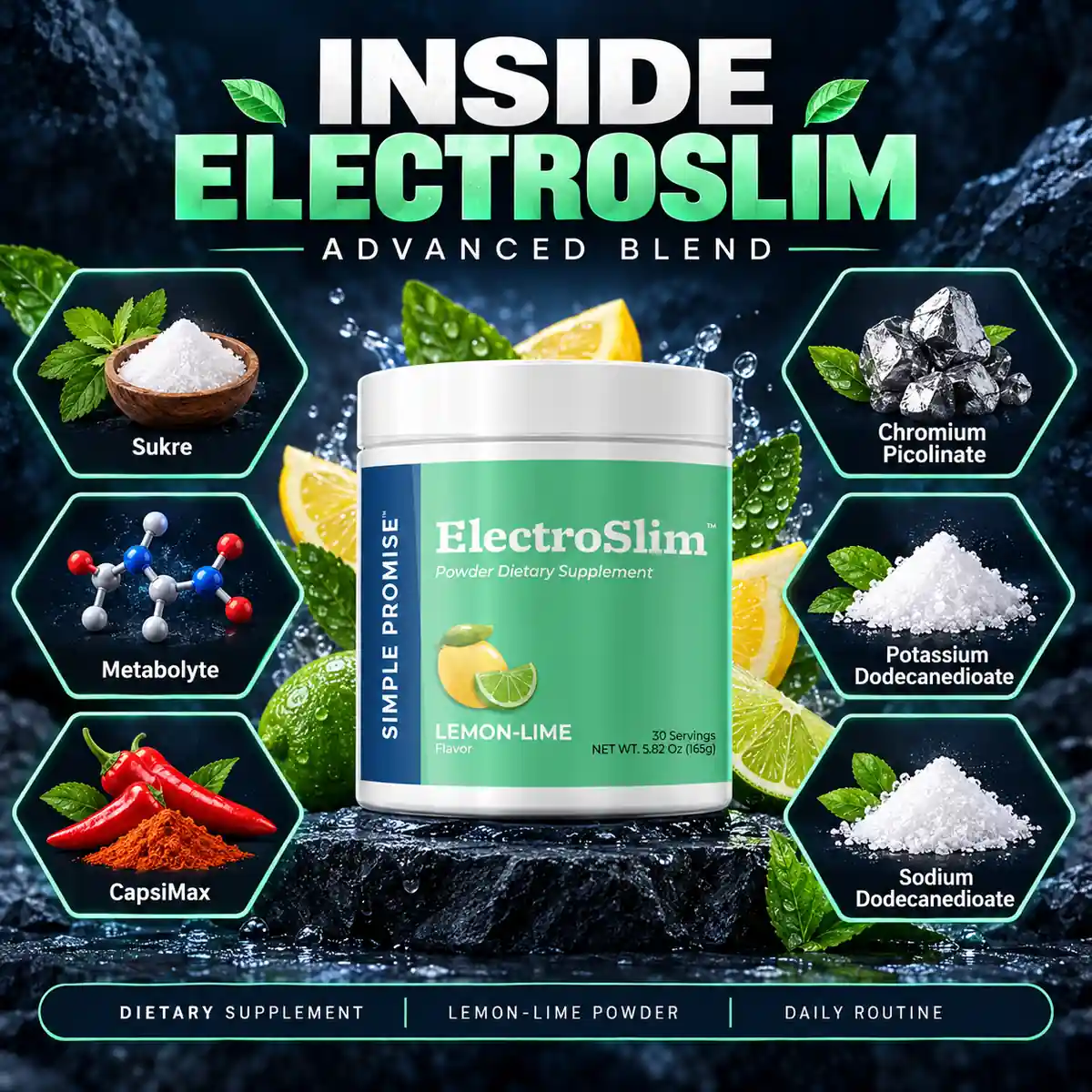
The seller’s material names chromium picolinate on an ingredients image and stops there. We asked for the Supplement Facts panel. If it arrives, the figure goes here and this section gets shorter.
Six named ingredients, one tub, and no published split between them:
Side effects and interactions worth knowing
At ordinary supplement doses chromium picolinate is generally well tolerated. Reported problems are mostly gastrointestinal: nausea, an upset stomach, occasionally headache. Case reports of more serious effects exist but are rare and typically involve very high doses over long periods.
The interaction that matters most is with diabetes medicine. If chromium nudges blood sugar downward and insulin or another glucose-lowering drug is already doing the same job, the combination is the thing to watch, not either one alone. Anyone in that position should ask their prescriber before adding it.
How to think about a trace mineral on a label
Trace minerals are easy to put on a label and hard to argue with. They sound scientific, they are genuinely essential, and almost nobody knows what a normal intake looks like, so any amount seems plausible.
A useful habit is to compare the amount on the label with the recommended intake. If it is close, the ingredient is a nutritional top-up. If it is ten or fifty times higher, the product is using it as an active ingredient and should be judged against the trials that used similar doses. If the amount is not printed at all, you cannot do either, and the honest response is to treat the ingredient as decoration until the number appears.
Find the amount
On the Supplement Facts panel, in micrograms for chromium.
Compare with 20–35 mcg
The adult adequate intake.
Decide which product you are holding
A top-up, or a study-sized dose.
Check your medicines
Especially anything for blood sugar.
Judge the claim accordingly
Appetite claims need study-sized doses, and even then the evidence is thin.
The bottom line
Chromium is essential, chromium picolinate absorbs reasonably well, and the research on it is mostly about blood sugar with a thin and inconsistent layer about appetite and weight. Reviews from NIH do not support it as a weight-loss ingredient.
For ElectroSlim specifically, the question cannot even be asked, because the amount is not published. That is not a reason to assume the worst about the product. It is a reason to buy it as a flavoured electrolyte drink you enjoy, and to ignore the chromium as a selling point until somebody prints the number.
Sources
- NIH Office of Dietary Supplements. Chromium: Fact Sheet for Health Professionals. NIH ODS, current revision. Checked September 23, 2026.
- NIH Office of Dietary Supplements. Dietary Supplements for Weight Loss. NIH ODS, current revision. Checked September 23, 2026.
- U.S. Food and Drug Administration. Beware of Products Promising Miracle Weight Loss. FDA consumer update. Checked September 23, 2026.
- U.S. Food and Drug Administration. Dietary Supplements: What You Need to Know. FDA, current revision. Checked September 23, 2026.
Questions on this topic
More answers on the full FAQ page.
Does chromium picolinate help you lose weight?
Reviews find effects on body weight small and inconsistent. NIH does not support it as a weight-loss ingredient.
How much chromium do adults need?
The adequate intake is about 20–35 micrograms a day, and most diets supply it.
How much chromium is in ElectroSlim?
Not published. No Supplement Facts panel was supplied to us.
Is chromium picolinate safe?
Generally well tolerated at supplement doses; stomach upset is the usual complaint. Ask a doctor first if you take diabetes medicine.

Ready to try ElectroSlim?
Pick a pack and see the price at checkout. The money-back guarantee is 60 days from purchase, unless the sales page prints a longer window. Questions first? Call the order desk at +1 (225) 293-8071.
Sold through a USA authorized ElectroSlim retailer. This site is not the manufacturer and earns when you buy.Keep reading
What electrolytes do
What electrolytes actually are, what sodium and potassium do in the body, when a drink mix…
Read more →Why the panel matters
What a Supplement Facts panel is required to show, what you can work out from it, what a m…
Read more →ElectroSlim ingredients
The six named ingredients, and what is missing.
Read more →